The Journal Tapping Method
Write It · Tap It · Release It
EFT Tapping for children, teens & parents
✦ Start session Subscribe — £12.99/mo
Home About The Journal Tapping Method Blog & Resources FAQ Contact Subscribe — £12.99/month
Write it. Tap it. Release it.

The Journal Tapping Method™

A simple, structured process that combines guided journaling and EFT tapping to help children, teens, and parents safely release stress, anxiety, and overwhelming emotions — at home, without needing complicated techniques or years of therapy.

Why journaling and tapping together
"Most emotional tools focus either on talking or on calming the body. The Journal Tapping Method does both at the same time."

When a child or parent writes, they activate the thinking part of the brain. This helps make sense of what has happened. But if the body is still stressed, the brain can stay stuck in protection mode. This is why just talking about a problem doesn't always make you feel better — you may understand what happened, but you still feel the stress in your body.

Tapping works directly with the nervous system. It sends calming signals to the brain and helps reduce stress hormones. This allows the brain to feel safe enough to process emotions properly.

When these two approaches are combined, the brain and body begin to communicate again. Emotional memories lose their intensity. The nervous system learns that it is safe to let go. This creates lasting change instead of temporary coping.

Calms the amygdala
The brain's alarm centre becomes very active when we are stressed. Tapping on acupressure points sends calming signals to the amygdala, helping it realise there is no real danger — even when the feelings are intense.
Lowers stress hormones
When the amygdala is activated it triggers cortisol and adrenaline — the stress hormones behind racing hearts, tight stomachs, and fast breathing. Tapping helps these hormones reduce, so the body can settle.
Your own words make it land
Generic scripts don't reach the right places. The Journal Tapping Method uses the exact words you wrote — your nervous system recognises them as true. That's when the emotional charge releases.
No talking required
Children don't have to explain everything out loud. They can write privately, use simple words, or focus on body sensations. The tapping process releases the stress without needing long conversations — this is why it works so well for teens.
What changes when you tap

Before and after tapping

Before tapping
When stress or anxiety is present
The amygdala becomes very active
Stress hormones flood the body
Racing heart, tight stomach, fast breathing
Thinking brain becomes less active
Hard to stay calm or solve problems
Feelings and memories feel overwhelming
After tapping
What the nervous system experiences
Calming signals reach the amygdala
Stress hormones begin to lower
The nervous system settles
Thinking brain becomes active again
Emotions can be processed safely
Emotional memories lose their intensity
The method — step by step

8 steps to emotional release

This process is simple enough to use every day and can be adapted for different ages and situations.

1

Choose one memory or problem

The child or parent chooses one specific situation, feeling, or memory to focus on. This could be something that happened that day, a worry about the future, or a difficult experience from the past.

Focusing on one thing at a time helps the brain and nervous system feel safe — and makes the process far more effective. Most people struggle with emotional work not because they're incapable, but because they start with something too big, too vague, or too emotionally loaded.

Good targets usually sound simple, such as:
"That argument on Tuesday night" · "When my teacher embarrassed me in class" · "When I got that message and my stomach dropped"

A helpful way to choose: gently think about a few possibilities and notice your body's response. The right issue is usually the one that creates a tightening, a sinking feeling, or a physical reaction straight away. Give the issue a title and write it clearly at the top of your page.
2

Write it — the journal dump

Write freely about what happened, how you feel, what you are thinking, and where you feel it in your body. This allows hidden worries and emotional triggers to come into awareness.

This step is not about understanding the situation. It is about expressing the emotional charge exactly as it exists in your body. Your writing might repeat the same sentence in different ways, jump between thoughts, feel uncomfortable to read back, or sound dramatic. That is not a mistake — that is emotional truth.

Include: what actually happened · what you felt emotionally (even if it feels irrational) · what you felt in your body · what you wanted to say or do but couldn't · what you decided about yourself in that moment
Do not: soften the language · explain yourself · justify why you felt that way · add positives. No one is going to see it. It doesn't need to be neat, have punctuation, or correct spelling. Write continuously for 5–10 minutes.
3

Rate the feeling — your first SUDS

Using the SUDS scale (0–10), rate how strong the emotion or body sensation feels right now. 0 means no emotional charge at all. 10 means maximum intensity for you.

When you finish writing, the memory is already present — your nervous system is activated. That's exactly why we measure now, before tapping.

Also notice where you feel it in your body — whether it feels tight, heavy, hot, buzzing, hollow, or pressured. If you're not sure what number, choose the first one that pops into your head. Don't overthink it. Write it down. This number is not a goal — it is simply a starting reference.
4

Tap three full rounds while reading your words

This is where The Journal Tapping Method becomes very different from traditional EFT. You are not trying to create a statement. You are not trying to think of the correct words. You are not searching for reminder phrases.

You have the words in front of you — your journal entry. Those are what you tap on. Your exact words. This is why people pay so much to see an EFT practitioner — because they word the script for you. This method takes away that worry entirely.

Tap through the EFT tapping points slowly and rhythmically, reading your journal entry as you go. Tap through all 9 points continuously for 3 rounds. Take your time. Really feel into the memory and your words.
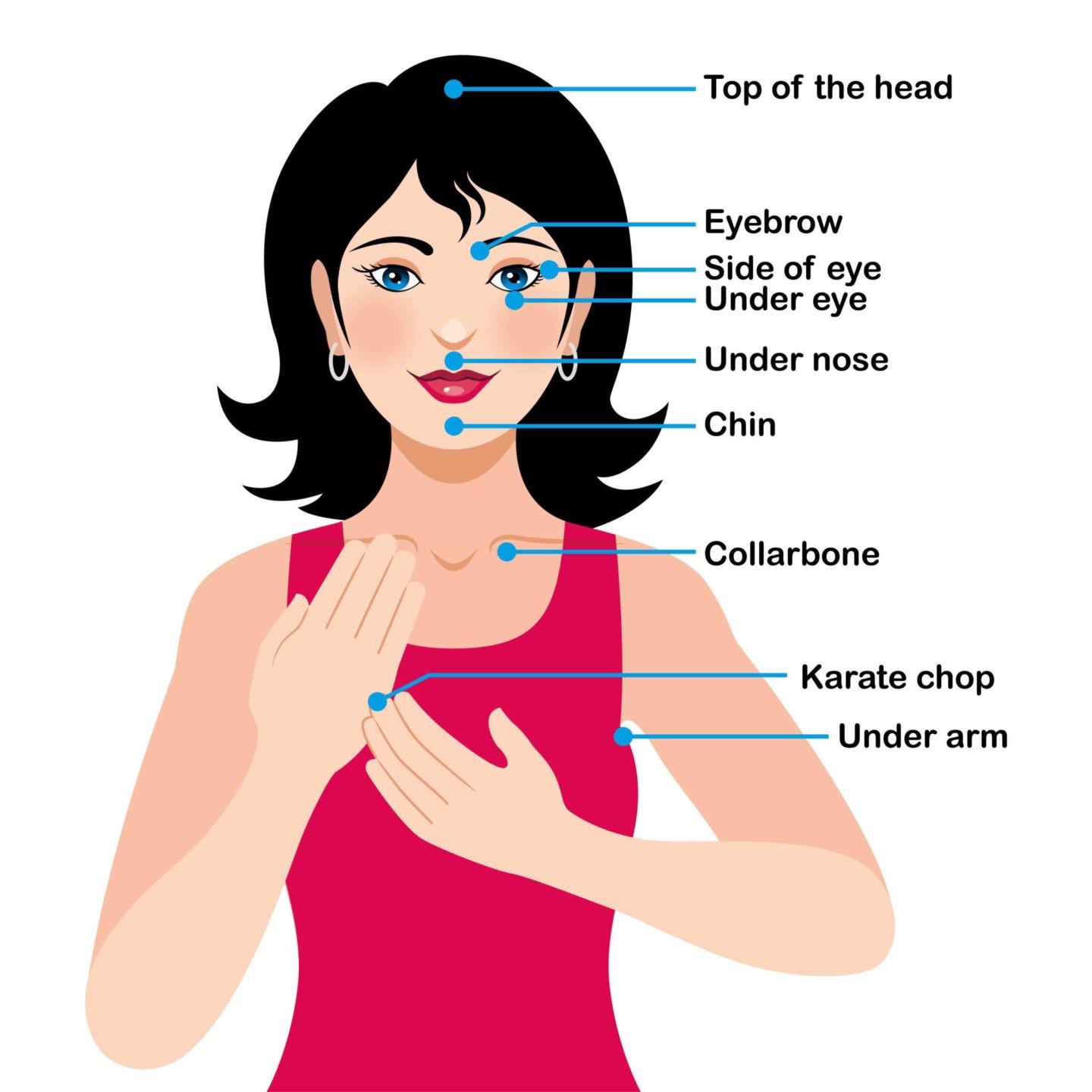
The 9 EFT tapping points

The 9 EFT tapping points used in every session

During these three rounds you might notice emotions rising before settling, sighs, yawns, tears, tiredness, irritation, or absolutely nothing. All responses are normal. The reason you tap three full rounds before stopping is to give the nervous system enough time to begin regulating before you assess anything.
5

Re-rate — your second SUDS

After tapping through the journal entry 3 times, pause completely. Take a deep breath. Read through your journal entry again and ask: what number is it now?

A drop of even 1 point means emotional energy has moved. Sometimes the number stays the same but feels less sharp. Sometimes the body shifts before the mind does. Write the number down.
6

Highlight trigger words and sentences

Read your journal entry slowly and notice what still activates you now, after tapping. Which words or sentences still bring up emotional charge when you read them?

Activation might show up as a body reaction, emotional discomfort, an urge to skim past a sentence, or tension as you read certain words.

Highlight or underline single words, short phrases, or full sentences. Write each one down the page as a list. Do not shorten them, improve them, or explain them. The exact wording matters because it came directly from your nervous system.

7

Tap on trigger words only

This step is targeted emotional discharge. Tap through the tapping points while focusing on one trigger word or sentence at a time. You can say it quietly, say it in your head, or simply focus on it.

Do not add positives. Do not soften the wording. Do not try to end on a good note. You are allowing the remaining emotional charge attached to those words to leave the body.
As you tap, notice sensations changing, emotions shifting, or new memories appearing. These are signs the nervous system is unwinding.
8

Third SUDS — and repeat if needed

After tapping the trigger words, pause completely. Read through your journal entry again from start to finish. What number is it now?

If you are down to a 0 or 1 — the session is complete. If not, re-highlight any words that still feel painful or any new trigger words that have appeared. List them and tap through again until you reach 0 or 1.

Tip: If your SUDS is going up, make sure you haven't changed your focus. Check you're still working on the exact same issue as in your original journal entry. If the issue has genuinely shifted to something new, that's fine — start the process again with the new issue.
Why this method works

This is more than a technique. It's a skill for life.

The Journal Tapping Method empowers both parent and child. Instead of feeling helpless, you learn how to work with the nervous system in a gentle, practical way.

No talking required
Children don't have to explain their feelings. They write privately, in their own words, in their own time. This removes the pressure that stops children opening up.
Use it at home, anytime
No appointment needed. No waiting list. No driving to a therapy room. This method works in the living room, before school, or whenever it's needed most.
Tracks real progress
The SUDS scale makes the invisible visible. Watching a number drop from an 8 to a 1 in one session builds trust in the process — for child and parent both.
🌿
Parents regulate first
The parent track matters as much as the child track. When you regulate, your whole home regulates. Co-regulation begins with you.
Builds emotional resilience
Children who learn this process develop lifelong self-regulation skills. They learn to trust their bodies, understand their emotions, and handle life's challenges.
Never stops too early
The method continues until the SUDS reaches 0 or 1 — not before. Real completion changes how the memory is stored in the body.
Strengthens connection
The process of working through emotions together deepens the bond between parent and child — even when the child is doing it independently.
🧠
Based in neuroscience
Every step has a reason grounded in how the nervous system works. This is not guesswork — it's what actually creates lasting change.
Using Nova with the method

Nova does the written method for you

Nova is the AI guide built into The Journal Tapping Method. She reads your journal entry and builds every tapping phrase from your exact words — so you never have to think about what to say. Just write, tap, and release.

Start a session with Nova →
1
Write your journal entry — Nova reads every word
2
Nova builds your tapping script from your exact language
3
Tap through 3 complete rounds, delivered all at once
4
Nova asks for your SUDS score after every 3 rounds
5
If SUDS is above 1, Nova builds a new script immediately
6
Session ends only when SUDS reaches 0 or 1
Ready to try it?

Join the families already using The Journal Tapping Method

One subscription. Two tracks. Unlimited sessions. £12.99/month — cancel anytime.

Start your membership today

🔒 Secured by Stripe · Cancel anytime